
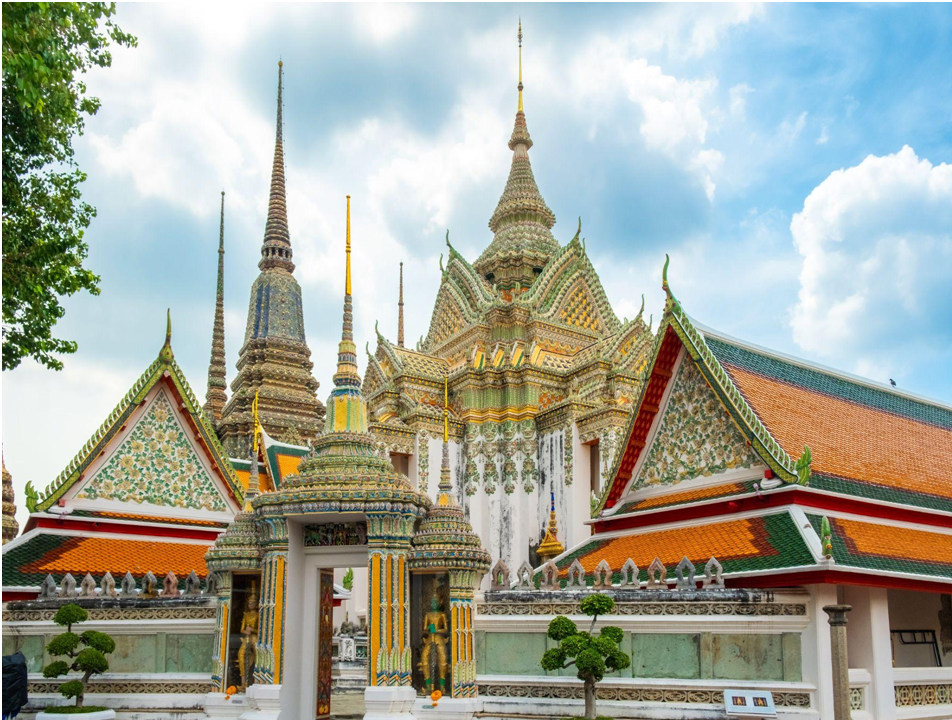
- Bangkok’s most famous temples are more than tourist attractions. They form part of the cultural fabric of daily life in the city.
- Wat Phra Kaew (Temple of the Emerald Buddha) within the Grand Palace complex is widely considered the most sacred Buddhist site in Thailand.
- Wat Pho houses the famous Reclining Buddha statue and is one of Bangkok’s oldest and largest temple complexes, also recognized as the birthplace of traditional Thai massage.
- Wat Arun along the Chao Phraya River is one of Bangkok’s most architecturally distinctive landmarks, with riverboat access from multiple city piers.
- Wat Saket (Golden Mount) and Wat Benchamabophit (Marble Temple) offer less crowded alternatives with significant cultural and architectural merit.
- Modest dress is required at all temples — shoulders and knees must be covered; sarongs are often available for hire at major sites.
- Plan for early morning visits for the most comfortable experience, with cooler temperatures, better light for photography, and significantly smaller crowds.
- Thailand Privilege Card provides Elite Personal Liaison (EPL) and Elite Personal Assistant (EPA) support that reduces administrative complexity, giving residents more time to explore Bangkok’s cultural environment.
A Guide to the Most Famous Temples to Visit in Bangkok, Thailand
Bangkok has over 400 Buddhist temples, known in Thai as wat. The most famous temples in Bangkok sit within walking distance or a short river taxi ride from the city’s primary residential and business districts. They are woven into the daily rhythms of local life, used for morning alms-giving, community gatherings, and religious festivals that mark the Thai calendar throughout the year. For anyone moving to Bangkok, familiarity with these sites is part of understanding the city.
Read More: 5 Amazing Dubai Boat Tours for a Luxury Water Experience
For those considering a long-term move to Bangkok, Thailand Privilege Card (formerly Thailand Elite Visa) provides visa stability and administrative support, enabling residents to settle with exclusive services and privileges.
The Most Famous Temples in Bangkok
Wat Phra Kaew, Temple of the Emerald Buddha
Wat Phra Kaew is widely regarded as Thailand’s most sacred Buddhist site. Located within the Grand Palace complex in the Rattanakosin district on the western edge of Bangkok’s historic center, it houses the Emerald Buddha, a 66-centimeter seated figure carved from a single block of jade, dating to the 15th century. The complex also contains some of the most detailed mural art in the country, depicting scenes from the Ramakien, the Thai adaptation of the Hindu epic Ramayana.
Entry to the Grand Palace complex costs THB 500 for foreign visitors. Modest dress is mandatory; sarongs are available at the entrance for those who arrive underprepared. Arriving before 9:00 AM significantly reduces wait times.
Wat Pho, Temple of the Reclining Buddha
Wat Pho is one of Bangkok’s oldest and largest temple complexes, predating the city’s founding. This famous Buddhist temple in Bangkok is home to the famous Reclining Buddha statue, a gilded figure 46 meters long and 15 meters high, its feet inlaid with 108 mother-of-pearl panels depicting auspicious characteristics of the Buddha.
Read More: Best Places to Visit Near Dubai for a Perfect Weekend Getaway
Wat Pho is also formally recognized as the birthplace of traditional Thai massage, and the on-site massage school and clinic remain active today. Located directly south of the Grand Palace and accessible by river ferry from Sathorn Pier, it is one of the most logistically convenient famous Buddhist temples in Bangkok for residents in the central and riverside districts. Entry costs THB 200-300 for foreign visitors.
Wat Arun, Temple of Dawn
Wat Arun sits on the western bank of the Chao Phraya River, directly across from Wat Pho, and is one of the most visually recognizable and famous Buddhist temples in Bangkok. Its central prang, a Khmer-style tower, rises 70 meters and is decorated with fragments of Chinese porcelain, creating a distinctive mosaic surface that catches the light particularly well at sunrise and in the late afternoon.
Visitors cross by a short river ferry from Tha Tien Pier for THB 5. Entry to the temple is THB 200 for foreign visitors. The elevated walkway around the central tower provides river views across to the Grand Palace complex.
Wat Saket, the Golden Mount
Wat Saket’s artificial hill, the Golden Mount, rises 58 meters above Bangkok’s flat central plain, providing panoramic views across the old city. A spiral staircase of 318 steps winds through gardens and past memorial plaques to the gilded chedi at the summit, which houses a relic of the Buddha.
Entry is THB 100 for foreign visitors. The temple is particularly worth visiting during the annual Golden Mount Temple Fair held in November, one of Bangkok’s most atmospheric festivals.
Wat Benchamabophit, the Marble Temple
Wat Benchamabophit is constructed almost entirely of Italian marble, giving it a visual character that distinguishes it immediately from Bangkok’s other major temples. Built during the reign of King Rama V at the turn of the 20th century, it is located near the Dusit district.
The temple’s cloisters house 52 Buddha images representing different national styles and historical periods. Entry is THB 100. Early morning visits align with the resident monks’ alms-giving round and provide a genuine sense of the temple as a functioning religious community.
Practical Guidance for Temple Visits
All Bangkok temples require modest dress, which means shoulders and knees must be covered for both men and women. Shoes are removed before entering any building housing a Buddha image. Photography is generally permitted in temple grounds but restricted inside certain buildings, particularly at Wat Phra Kaew; follow posted signage.
The most comfortable visiting hours across all sites are before 9:00 AM and after 4:00 PM. Midday visits between April and June, during Bangkok’s hottest season, involve direct sun exposure in largely unshaded outdoor compounds. Carrying water and wearing light, breathable clothing is advisable year-round.
How Thailand Privilege Card Supports Life in Bangkok
Thailand Privilege Card provides long-term visa privileges that remove the renewal cycle many long-term residents manage annually. Elite Personal Assistant (EPA) services provide VIP airport facilitation at Suvarnabhumi and Phuket international airports. Elite Personal Liaison (EPL) assists with government administrative processes, such as 90-day address reporting and bank account opening. Member Contact Center (MCC) provides an ongoing dedicated support channel throughout the membership period.
Here are the different membership tiers offered
- Bronze membership grants a 5-year Visa for THB 650,000 for a limited-time offer
- Gold Membership grants a 5-year visa for THB 900,000 for an expanded suite of privileges
- Platinum Membership grants a 10-year visa for THB 1,500,000
- Diamond Membership grants a 15-year visa for THB 2,500,000
- Reserve Membership grants a 20-year visa for THB 5,000,000
Important notice
All Thailand Privilege Card membership tiers grant long-term visa status. Members are not permitted to work or study in Thailand with their membership.
Make Bangkok, Thailand, Your New Home
Starting with Thailand Privilege Card Platinum membership, plan your relocation as a long-term resident in Thailand with Thailand Privilege Card. To learn more about the visa structure that enables long-term Bangkok residency, visit Thailand Privilege Card page for full membership details.
Please note that all Thailand Privilege Card membership fees, benefits, and offers mentioned in this article are subject to change. For the most current pricing and terms information, please visit the official Thailand Privilege Card website or contact our Member Contact Center (MCC) directly.